
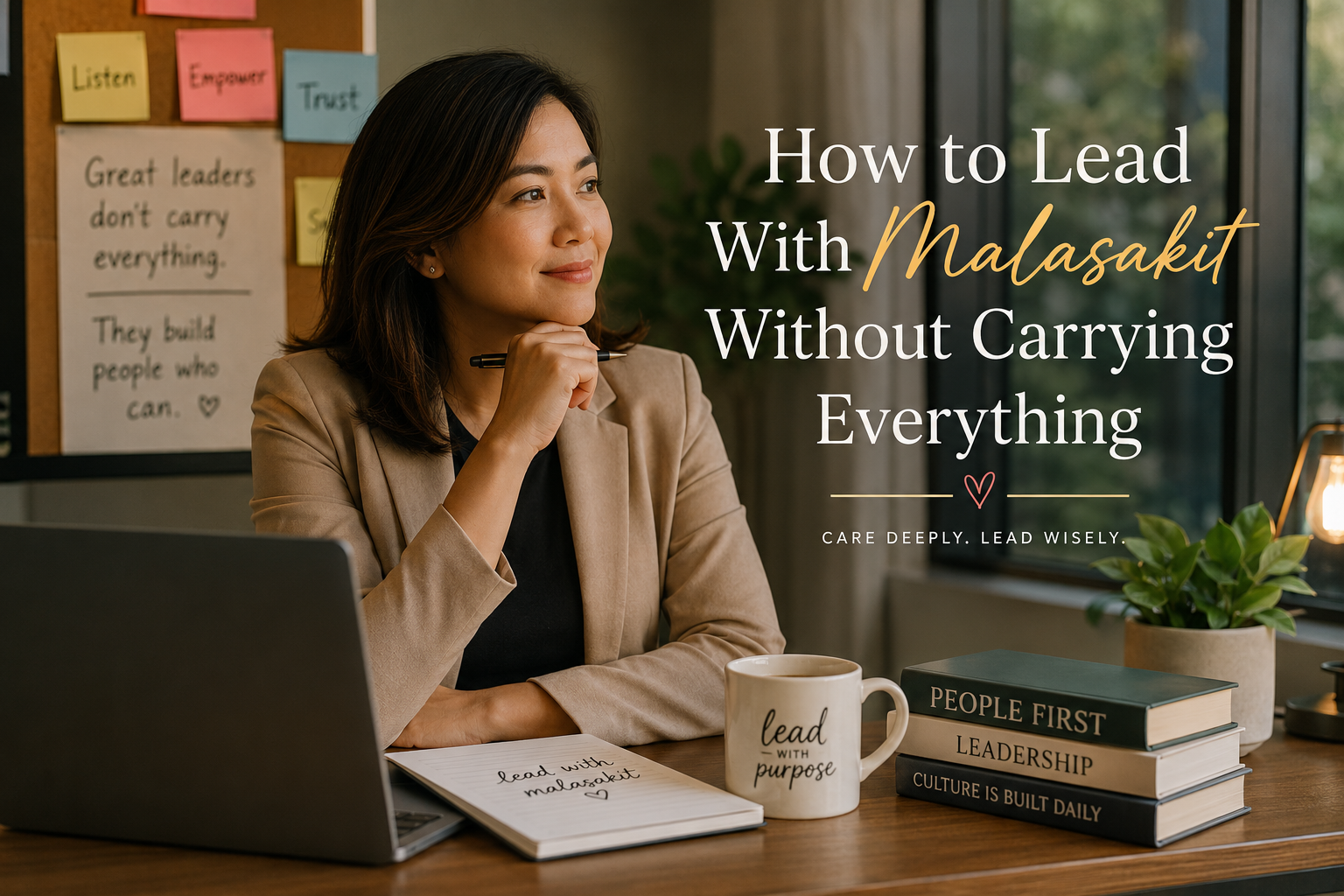
A Filipina leader opens her laptop early in the morning, and before the first meeting begins, the day is already asking a lot from her. There are messages waiting from a team member who needs reassurance, a client concern that needs a careful reply, and a deadline that may need to be adjusted because someone is overwhelmed. At home, there are also people who need her attention, patience, and presence. She takes a deep breath, starts responding, and does what many caring leaders do almost automatically: she holds things together.
From the outside, she looks calm, capable, and dependable. Inside, she is already tired. This is the quiet weight many leaders carry when they are used to being the strong one, the understanding one, and the person people run to when things feel unclear. At first, it feels like trust. Over time, if there are no boundaries or systems around that trust, it can start to feel heavy.
This is where many women leaders find themselves. They genuinely care about the company, the people, the clients, the goals, and the culture. They want everyone to feel supported. They want to lead with kindness. They do not want to become harsh or cold. But somewhere along the way, care can turn into over-carrying, and even sincere malasakit can become exhausting.
This is why compassionate leadership Philippines needs a deeper conversation. Malasakit is a beautiful strength. It is one of the best things about Filipino leadership because it creates warmth, loyalty, and shared humanity. But malasakit without boundaries can slowly become invisible labor, and invisible labor does not stay invisible forever. You will notice it in tired leaders, delayed decisions, unclear expectations, and teams that become dependent instead of empowered.
When a company becomes unattractive for top-performing people to choose to stay, the issue is not always salary or benefits. Sometimes, the workplace simply feels too heavy. Leaders may care deeply, but if the culture has no structure, the most dependable people often end up carrying the most. That is not sustainable growth. That is quiet depletion.
The Problem With Caring Too Much Alone
Many leaders do not get tired because they lack passion. They get tired because they care deeply without enough support. They think about business goals, team morale, client expectations, family responsibilities, reputation, fairness, and the future of the company. They want things to work, and they want people to grow. That kind of heart is a gift, but it also needs wisdom.
For many Filipina leaders, this can feel personal. Women are often expected to be strong, nurturing, emotionally aware, and excellent at the same time. They are praised for being understanding, yet they are also expected to absorb more. Because they listen well, people trust them. But trust can become heavy when every concern keeps landing on the same person.
This leader often becomes the one people approach when something feels unclear. She may be asked to soften difficult messages, notice who is discouraged, check on morale, and keep the team emotionally steady. That may look like strength, and in many ways it is. But if the same leader keeps holding all of that without support, the strength eventually becomes strained.
Gallup’s State of the Global Workplace 2026 report found that only 20% of employees worldwide were engaged in 2025. It also estimated that low engagement cost the global economy around $10 trillion in lost productivity. That number is not just an HR statistic. It is a signal that people do not become engaged because a company has a nice mission statement. They become engaged when their daily experience of work feels clear, fair, human, and meaningful.
In the Philippines, this matters even more now. The Philippine Statistics Authority reported that underemployment reached 15.2% in April 2026, with 7.41 million employed Filipinos wanting additional hours, additional work, or a better job. Many employees are not just thinking about work. They are thinking about stability, family needs, finances, growth, and whether their current workplace can still support the life they are trying to build.
When leaders are stretched thin, the whole workplace feels it. Meetings may still happen, reports may still get submitted, and people may still smile and say “okay lang,” but the energy changes. There is less honesty, less ownership, less creativity, and more emotional distance. This is why employee engagement Philippines should not only be measured through surveys or company events. It should be felt in the daily culture of the company.
Do people feel safe to speak? Do leaders feel supported enough to lead well? Are high performers protected from being overused? Do managers know how to care without carrying everything? These questions are not soft. They affect performance.
Malasakit Is Not the Problem
Malasakit is not the problem. The problem begins when care replaces clarity.
A leader may keep extending deadlines because she understands everyone’s situation. That may be kind once or twice, but if expectations are always adjusted without honest conversations, accountability becomes blurry. She may make herself available all the time because she wants the team to feel supported, but if every concern becomes urgent, she loses the space to think, plan, and lead.
There is also the quiet tendency to avoid difficult feedback because no one wants to hurt anyone. Yet without honest feedback, people do not grow. A leader may absorb complaints privately because she wants to protect peace, but when there is no healthy process for tension, she becomes the emotional shock absorber of the company.
This is where many good leaders get stuck. They think they have to choose between being compassionate and being firm, but that is not true. You can be kind and still be clear. You can listen and still decide. You can understand someone’s situation and still hold them accountable. You can protect dignity while naming what needs to improve. That is not cold leadership. That is mature leadership.
Why This Affects Company Growth
Some companies still treat wellbeing as something separate from business. It is placed under HR, discussed during wellness month, or turned into a webinar, poster, or one-time activity. Those things can help, but they are not enough. Wellbeing affects retention, productivity, decision-making, collaboration, trust, and leadership capacity.
AXA Philippines reported that 87% of Filipino workers experienced at least one work-related mental health issue, higher than the global average of 76%. These issues included tiredness, trouble sleeping, stress and anxiety, difficulty concentrating, loss of interest, loss of self-confidence, feelings of worthlessness, and appetite or eating concerns. That should make leaders pause because when people are mentally and emotionally strained, they may still work, but the quality of their presence changes.
A person can attend meetings but contribute less. They can follow instructions but stop offering ideas. They can meet deadlines while feeling disconnected inside. They can stay in the company, but only because they are not ready to leave yet. This leads to a workplace that still functions on paper, but slowly loses trust, energy, and creativity.
The Philippine Information Agency also reported in May 2026 that HR managers were urged to focus on employee wellbeing, purpose-driven workplaces, continuous learning, leadership development, and meaningful participation. The message is simple: companies grow better when people grow better.
This is not about being too soft. It is about being wise. A company that treats people only as resources will eventually feel the cost. It may show up through turnover, disengagement, weak leadership pipelines, unresolved conflict, or the loss of good people who quietly decide that they can no longer see a future in the organization. The bottom line matters, but people shape the bottom line, and culture shapes people.
The Hidden Pattern of the Caring Leader
There is a certain kind of leader who is most likely to over-carry. She is responsible, reflective, and emotionally aware. She notices people. She values excellence. She wants to do things well. She does not want to hurt others, and she wants the team to feel safe while still helping the company succeed.
Because she is steady, people trust her. But trust can become heavy when there are no limits. She may begin the day responding to other people’s concerns before touching her own priorities. She may move her work again because someone else needs help. Rest becomes negotiable, and saying no feels like rejection.
Over time, she may keep holding tension because she believes that is what mature leaders do. At first, this feels noble. Eventually, it becomes unsustainable. The difficult part is that the company may not notice right away because she is still performing. She is still showing up, still smiling, still delivering, and still being praised for being strong.
Wise organizations do not wait for their best people to break before they pay attention. They ask better questions earlier. Who keeps carrying the emotional load of the team? Who is always adjusting? Who is trusted but not supported? Who keeps absorbing issues that should already have a system? Who gets praised for strength but rarely gets space to recover?
A company cannot build a champion culture by quietly exhausting the people who care the most.
Previous Strategies vs. What the Current Workplace Requires
Many companies are still using old leadership habits for a workplace that has already changed. Some of these habits came from good intentions, but today, they are no longer enough.
| Previous Strategy | What It Often Creates | What the Current Workplace Requires |
|---|---|---|
| Always be available to the team | Leaders become reactive and tired | Clear access, escalation rules, and protected focus time |
| Treat the workplace like family | Boundaries become blurry | Respect, fairness, care, and adult accountability |
| Keep the peace | Issues stay hidden until they become expensive | Honest conversations handled with dignity |
| Motivate people to work harder | Short-term effort, long-term fatigue | Purpose, clarity, realistic priorities, and support |
| Let HR handle people concerns | Leaders outsource culture | HR and leaders build culture together |
| Give more work to dependable people | High performers become overused | Contribution is recognized, protected, and developed |
| Offer wellbeing as an event | Care feels occasional | Wellbeing becomes part of leadership and workload design |
| Focus on results first and people later | Trust declines over time | People and performance are managed together |
The conversation around employee engagement Philippines can no longer stay at the level of morale. Employees are asking deeper questions now. Will I grow here? Will I be respected here? Will my leader listen? Can I succeed here without losing myself? Does this company care only about my output, or also about my humanity?
These questions affect whether good people stay. They also affect whether leaders can keep leading well and whether the company becomes a place where people can give their best without slowly losing themselves.
How to Lead With Malasakit Without Carrying Everything
The good news is that leaders do not need to become cold to become healthier. They just need better rhythms, clearer agreements, and support. Most of all, they need permission to stop confusing sacrifice with effective leadership.
1. Be honest about what you are carrying
Before setting a boundary, notice the load. Ask yourself what is truly yours to carry, what you have taken on because no one else is owning it, and what you may be holding because you are afraid to disappoint people. It also helps to ask what keeps repeating because the system is unclear, and what kind of support you may be giving that prevents someone else from growing.
This is not about blaming yourself. It is about seeing the pattern. Many leaders only know they feel tired, but tiredness often has a message. It tells you that something in the way work is happening needs to be reviewed.
2. Know the difference between care and rescue
Care helps people grow. Rescue takes the growth away from them. Care says, “I am here to support you as you move through this.” Rescue says, “I will take this from you so you do not have to feel uncomfortable.”
This matters because leaders can become rescuers without realizing it. They step in too quickly, solve too much, absorb the discomfort, and make things easier in the moment. The problem is that a team that is always rescued may stop building confidence. A team that is supported well learns ownership.
3. Set expectations before you feel resentful
Many boundaries sound harsh because they are expressed too late. By the time the leader speaks, frustration has already built up. It is healthier to set expectations while the relationship is still calm.
You can say, “For urgent matters, please message me directly. For non-urgent concerns, let us bring them to our weekly check-in.” You can also say, “I want to support you, and I also want you to come with your recommendation before we discuss next steps.” Another helpful line is, “I can help with alignment, but I cannot be the final owner of every detail.”
These are simple sentences, but they change the culture. They show that care is present, but ownership is shared.
4. Protect your strategic work
A leader who spends the whole day responding may eventually stop leading. Leadership needs thinking time. It needs space to prepare, decide, observe patterns, and guide the future.
That may mean blocking decision-making time, setting meeting-free hours, creating office hours for team concerns, training managers to handle first-level issues, or reviewing whether your calendar reflects your real priorities. Your calendar tells the truth. It shows what you protect, and it also shows what you keep sacrificing. If your most important priorities are always the first to be moved, your leadership will eventually feel scattered.
5. Build systems around care
Care should not depend on one kind person. If a company’s culture is healthy only because one leader keeps absorbing everything, the culture is fragile. Care needs structure.
That can look like regular one-on-one conversations, workload reviews, manager coaching, feedback channels, team agreements, leadership development, conflict support, recognition practices, and clearer escalation paths. This is why leadership coaching Philippines can be valuable for organizations that want healthier leadership. Leaders need guided spaces where they can understand their patterns, strengthen communication, and support people without losing themselves.
6. Practice accountability with dignity
Accountability does not need shame to be effective. In fact, shame often weakens ownership. People may comply because they are afraid, but fear usually creates hiding, defensiveness, and silence.
Dignified accountability sounds like, “This did not meet the standard. Let us discuss what happened and what needs to change.” It can also sound like, “I understand the situation, and we still need to address the impact,” or “I value your contribution, and I also need to be clear about the expectation.” This kind of leadership is not permissive. It is clear. It protects the person while addressing the issue.
7. Stop making your wellbeing optional
Leaders often tell their teams to rest, but do not rest themselves. They encourage balance, but model overextension. They ask people to speak honestly, but never admit when they need support.
Teams learn from what leaders normalize. If exhaustion is constantly modeled, people will treat exhaustion as part of the culture. If clarity, recovery, honest conversation, and shared ownership are modeled, people begin to understand that performance does not require self-abandonment. Your wellbeing is not separate from your leadership. It shapes the quality of your leadership.
Questions Every Caring Leader Can Ask This Season
If this article feels personal, pause for a moment. Not to judge yourself, but to listen.
Ask yourself where you are leading from genuine care and where you may be leading from fear. Notice where you have confused availability with value. Reflect on what your team truly needs from you, and what they may need to learn to carry themselves. You may also ask where you have avoided clarity because you wanted to be kind, and what might change if you led with both warmth and structure.
These questions are not soft. They are strategic. The way a leader relates to herself often becomes the way she leads others. A leader who never pauses may create a team that does not know how to pause. A leader who never protects priorities may create a culture where everything feels urgent. A leader who avoids hard conversations may train people to hide the truth until it is too late.
But a leader who grows in clarity can create clarity. A leader who practices dignity can create dignity. A leader who leads from alignment can help others become more aligned too.
Do Not Be Afraid to Try a New Strategy
Many companies keep returning to familiar solutions: another seminar, another team activity, another values campaign, another motivational talk, or another reminder to communicate better. Some of these can help, but when the root issue is deeper, the solution needs to go deeper too.
If leaders are tired from carrying too much, inspiration is not enough. They need reflection, tools, coaching, and support. If teams are disengaged, activities are not enough. They need trust, clarity, and alignment. If managers avoid hard conversations, policies are not enough. They need practice, confidence, and emotional maturity.
When culture feels heavy, the company may not need another slogan. It may need a new way to understand the people, patterns, and pressures shaping daily work. Companies do not need to wait until people resign before investing in growth. They can begin while people still care. That is the better time.
From Coping to Champion
Many people inside organizations are still coping. They are managing pressure, unclear expectations, emotional fatigue, change, conflict, and the constant demand to perform even when they are not fully well.
But people were not made only to cope. They were made to grow.
The shift from coping to champion does not happen by forcing people to be stronger. It happens when people are guided to understand what drives them, what shaped them, what strengthens them, and what gives their work meaning. This kind of transformation is not surface-level. It begins at the core.
When people become clearer inside, they often begin to lead, communicate, decide, and contribute differently outside. This is the kind of work that matters now because the companies that will thrive in this season are not only the ones with strong products, clear targets, and ambitious plans. They are the ones that know how to grow people with dignity.
Why Greatfull Consultancy Can Help
At Greatfull Consultancy, we believe people development should not only focus on skills and strategy. Skills matter. Strategy matters. Performance matters. But without inner alignment, growth becomes inconsistent. Leaders become tired. Teams become disconnected. Culture becomes reactive. Potential remains untapped.
This is why the heart of Greatfull Consultancy is Core Cognition Transformation, or CCT™. CCT™ is designed to unlock each individual’s Core Gifts and align identity with performance. Through this framework, individuals and teams are guided to understand their Passion, Potential, Pain, Power, and Purpose, creating a healthier roadmap for growth and development.
The goal is not simply to make people work harder. The goal is to help people lead and perform from a more aligned place, with clarity, confidence, and purpose.
This foundation supports Greatfull Consultancy’s programs, including Quality People Development, Unleash Champions Teambuilding, Strategic Planning, Culture Building, Communications Development, Personal and Professional Branding, and Core Cognition Transformation Coaching.
For organizations searching for compassionate leadership Philippines, Greatfull Consultancy offers a grounded, human, and practical approach to transformation. We support leaders who want results, but not at the cost of their people. We help teams move from coping to champion by addressing the deeper patterns behind performance, communication, trust, and culture.
For companies exploring leadership coaching Philippines, Greatfull Consultancy provides support that is practical, reflective, and rooted in real organizational needs. Our coaches do not simply motivate people for a day. They help leaders and teams look honestly at what is happening beneath the surface, then guide them toward healthier alignment, clearer communication, and more sustainable growth.
If your organization is ready to build a culture where people can grow with dignity, balance, and care, Greatfull Consultancy can help you begin that shift.
To learn more about Core Cognition Transformation and Greatfull Consultancy’s programs, you may reach us through:
Website: https://greatfullconsultancy.com
Facebook: https://www.facebook.com/greatfullconsultancy
Instagram: https://www.instagram.com/greatfullconsultancy
Email: info@greatfullconsultancy.com
Phone: 0927.268.1720
Office Address: Unit 2001 OMM Citra Bldg., San Miguel Avenue, Bgy. San Antonio, Pasig City 1605
Greatfull Consultancy helps organizations unlock CORE Gifts and unleash champions from within because when people are aligned at the core, leadership becomes more human, culture becomes more intentional, and performance becomes more sustainable.
References
AXA Philippines. (2024). 87% of Filipinos report work-related mental health issues, exceeding global average. https://www.axa.com.ph/multimedia/newsroom/87-of-filipinos-report-work-related-mental-health-issues-exceeding-global-average
Gallup. (2026). State of the global workplace 2026. https://www.gallup.com/workplace/349484/state-of-the-global-workplace.aspx
Greatfull Consultancy Corp. (2026). Greatfull Consultancy Corp. https://greatfullconsultancy.com/
Organisation for Economic Co-operation and Development. (2026). Philippines: OECD economic outlook, volume 2026 issue 1. https://www.oecd.org/en/publications/oecd-economic-outlook-volume-2026-issue-1_2d1956f0-en/full-report/philippines_bbb23a9d.html
Philippine Information Agency. (2026, May 15). HR managers urged to focus on employees’ well-being. https://pia.gov.ph/news/hr-managers-urged-to-focus-on-employees-well-being/
Philippine Statistics Authority. (2026, June 9). Number of employed persons in April 2026 increased to 48.89 million Filipinos aged 15 years and over. https://psa.gov.ph/statistics/labor-force-survey
Leave a Reply