
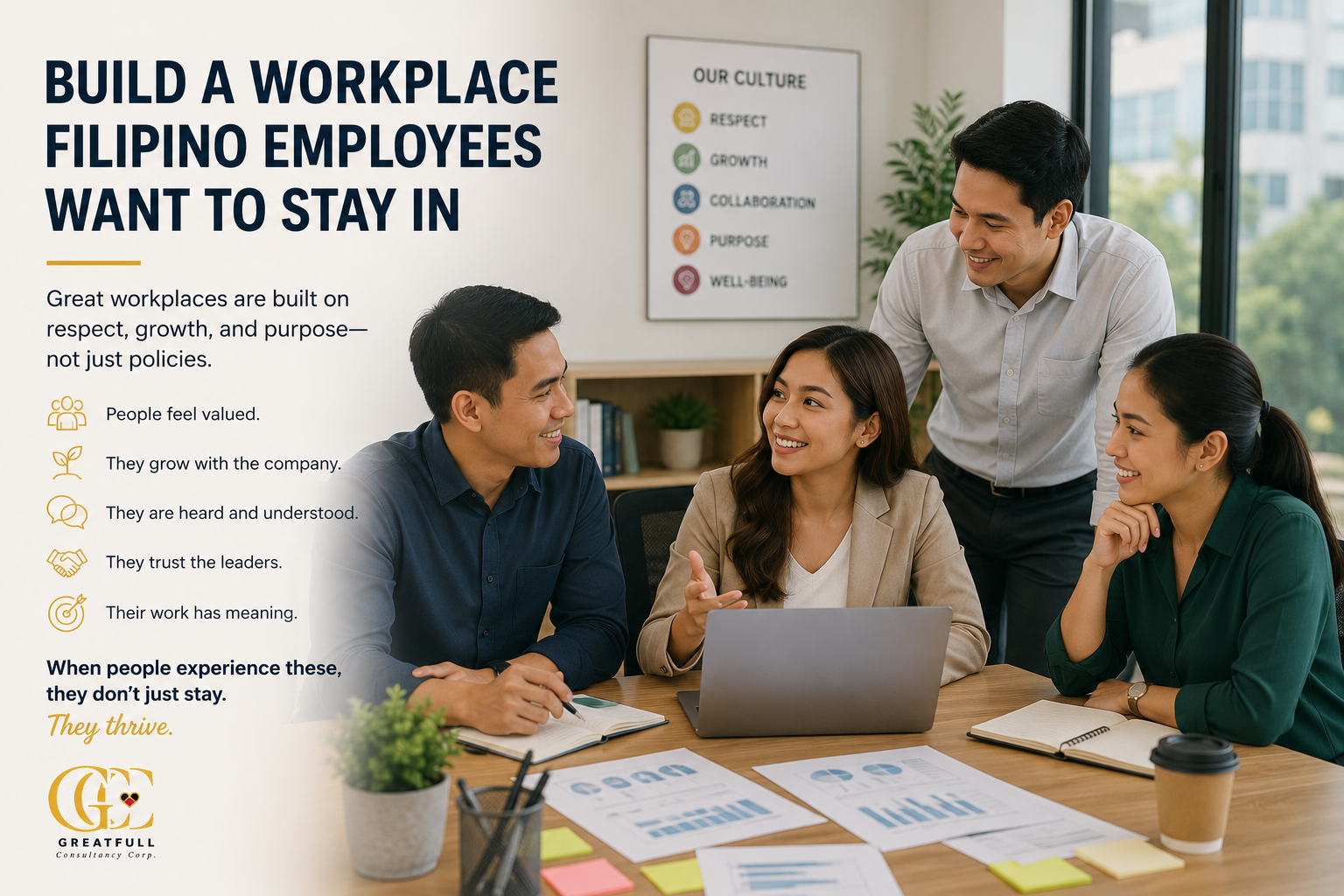
How to Build a Workplace Filipino Employees Want to Stay In
When Good Employees Start Leaving Quietly
A senior employee quietly updates her résumé after office hours.
Not because she hates the company. Not because she is being ungrateful. Not even because another employer has already made an offer.
She leaves because somewhere along the way, she stopped feeling like a person and started feeling like capacity.
She still attends meetings. She still replies to messages. She still says, “Noted po.” But inside, she has already begun to detach.
This is the part many organizations miss.
People do not always leave loudly. Sometimes, they leave months before they resign.
And after Labor Day, this question becomes sharper for Philippine companies:
The Post-Labor Day Question Leaders Should Ask
The Post-Labor Day Question Leaders Should Ask
Labor Day often brings attention to wages, rights, and worker dignity. But for companies, it should also become a leadership checkpoint.
Not simply:
“Are we compliant?”
But:
“Are our people still experiencing dignity, balance, and care here?”
This matters because HR is no longer just an administrative function. It is now directly connected to business continuity.
Recent Philippine workplace reports show why this matters. Great Place To Work Philippines cited Aon’s 2025 Human Capital Employee Sentiment Study, which found that 64% of employees in the Philippines are either actively changing employers or considering a move within the next 12 months.
Sprout’s 2026 retention guide also notes that employee retention remains a major challenge for Philippine businesses, citing a median tenure of only about 1.8 years among Filipino employees based on its State of HR 2025 report.
The Business Manual also reported that the Philippines recorded a 20% employee attrition rate in 2025, described as the highest turnover rate in Southeast Asia.
These numbers point to a hard truth:
People are not waiting forever for companies to change.
The Cost of Becoming an Unattractive Workplace
When a company becomes unattractive to good people, the damage does not begin on the resignation date.
It begins much earlier.
It begins when employees stop speaking up.
When they stop offering ideas.
When they stop volunteering for growth.
When they do only what is required.
When they emotionally disconnect, even while still performing.
This kind of quiet disengagement is costly because it affects more than one person’s role. It affects morale, execution, customer experience, leadership trust, and the company’s ability to grow.
For top performers, staying is not only about compensation anymore.
They are also asking:
Will I be respected here?
Will I grow here?
Will this workplace still allow me to have a life?
Will my contribution matter?
That is not softness.
That is strategy.
The Taboo Practice: “Maraming Naghahanap ng Trabaho”
One of the most dangerous assumptions in some Philippine workplaces is this:
“If they leave, we can replace them.”
Technically, yes. A company can hire another person.
But can it easily replace trust? Institutional memory? Client relationships? Quiet leadership? Team stability? The emotional safety that one mature employee brings to a department?
Not so easily.
The belief that people are replaceable often creates a culture of silent compliance. Employees follow instructions, but they stop contributing honestly. They attend meetings, but they no longer believe what is said. They do their jobs, but they stop giving discretionary effort.
You may be able to fill a vacant seat.
But you may not be able to recover the culture damage created by treating people as disposable.
What Retention Really Requires Now
The old thinking says retention is about keeping people from leaving.
But today, retention is really about building a workplace where staying still makes sense.
That means leaders must look beyond salary, benefits, and occasional team-building events.
Those things matter, yes.
But they are not enough when employees no longer feel respected, heard, developed, or supported.
A stronger workplace pays attention to:
- Leadership behavior
- Workload expectations
- Psychological safety
- Growth opportunities
- Recognition
- Communication
- Manager maturity
- Employee wellbeing
- Trust
These are not “extra” concerns.
They are part of how companies protect performance and continuity.
Closing Thought: What Kind of Workplace Are We Asking People to Stay In?
The real problem is not just that people are leaving.
The deeper problem is that many companies have become places where good people no longer see a future worth staying for.
After Labor Day, the better question is not only:
“How do we make people stay?”
It is:
“What kind of workplace are we asking them to stay in?”
Because people stay longer when they feel seen.
They contribute better when they feel trusted.
They grow deeper when they feel supported.
And they perform with more ownership when they know their dignity is protected.
How Greatfull Consultancy Can Help
At Greatfull Consultancy, we help organizations look beyond compliance and begin building workplaces where people feel seen, valued, and aligned with the company’s direction.
Through our people-development work, we help leaders understand what their teams need not only to perform, but to stay, grow, and contribute with purpose.
If your company is ready to build a healthier workplace culture rooted in clarity, care, compassion, and sustainable performance, we can help you begin with the right conversation.
Visit greatfullconsultancy.com to learn how Greatfull Consultancy can support your organization’s culture and people-development goals.
References:
Great Place To Work Philippines. (2026). The trust deficit: Why 64% of Filipino workers are planning to leave their jobs. Great Place To Work Philippines.
https://greatplacetowork.com.ph/insights/the-trust-deficit-why-64-of-filipino-workers-are-planning-to-leave-their-jobs/
Sprout Solutions. (2026, January 20). The 2026 retention playbook: 15 strategies to keep your best Filipino talent. Sprout Solutions.
https://sprout.ph/articles/retention-playbook-filipino-talent/
The Business Manual. (2026, April 18). How to retain employees in 2026. The Business Manual.
https://thebusinessmanual.ph/business-101/how-to-retain-employees-in-2026/
Leave a Reply